
Industry & Intelligence
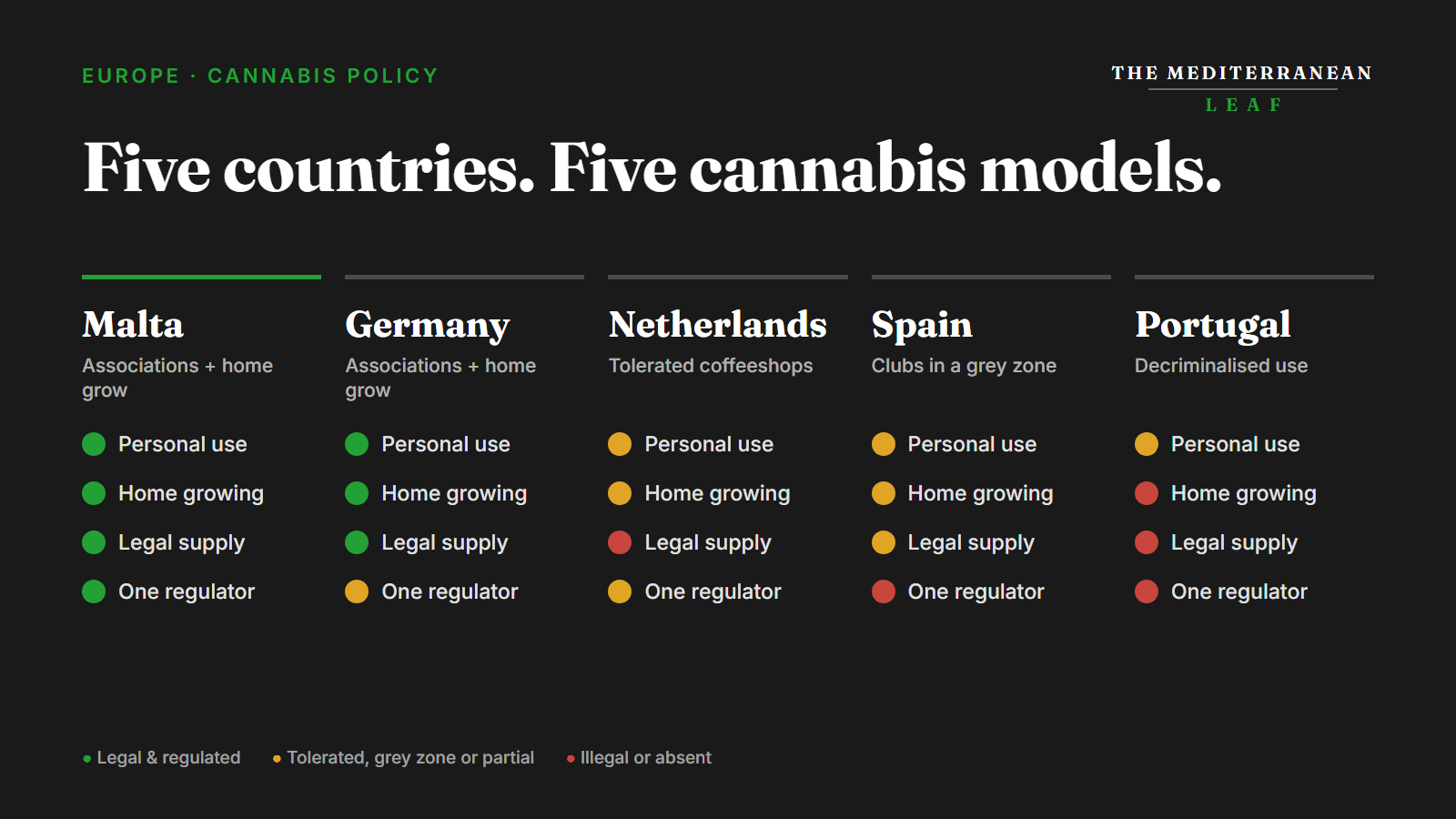
Europe does not have one cannabis policy. It has a patchwork, and the countries most often held up as "liberal" got there in very different ways. Some stopped punishing users. Some tolerated sellers. A few wrote new laws from scratch.
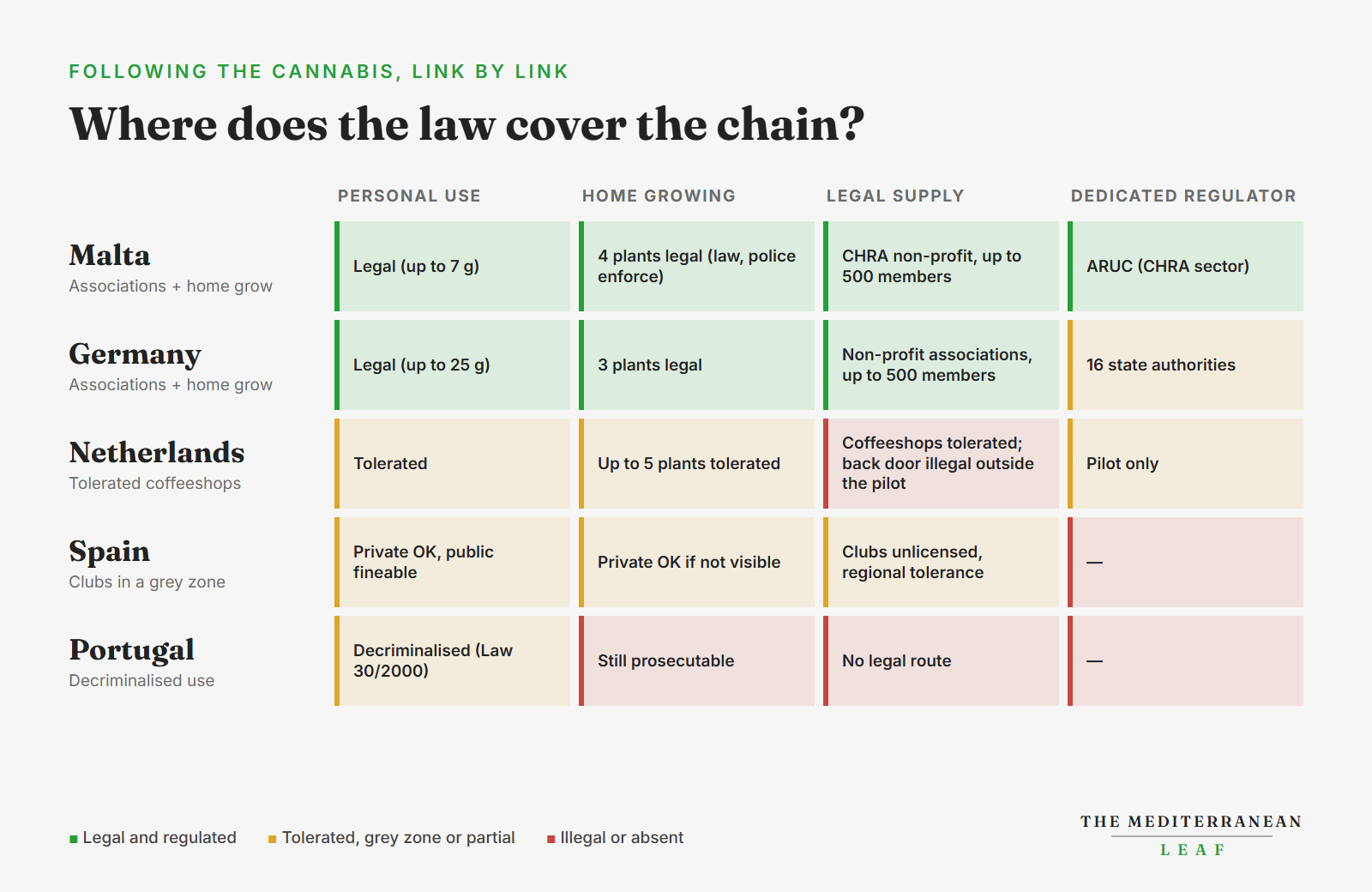
The simplest way to compare them is to follow the cannabis itself, from the plant to the person who uses it, and ask one question at every step: does the law cover this link, or does it look the other way? We looked at four links: personal use, home growing, legal supply, and a regulator that oversees the supply chain.
Portugal: the user is protected, the supply is not
Portugal is famous for decriminalisation, and rightly so. Since July 2001, under Law 30/2000, possessing up to a ten-day supply of any drug for personal use has been an administrative matter, not a crime. People caught with small amounts are referred to a dissuasion commission, made up of a social worker, a psychiatrist and a lawyer, which can issue a warning or a fine or suggest treatment.
What Portugal never did was legalise anything. Growing cannabis, even a few plants at home for personal use, can still be prosecuted, and selling it remains a crime. A medical cannabis law followed in 2018, but there is no legal route for adults to obtain cannabis for personal use. The user is protected; where the cannabis comes from is left to the illicit market.
Spain: clubs the law never wrote in
Spain's cannabis social clubs are often described abroad as legal. They are not. Using cannabis in private falls outside the Criminal Code, which targets distribution, but possessing or consuming it in public is an administrative offence under the 2015 public security law, with fines starting at €601. Growing a few plants for personal use in private is treated the same way: not a crime, but fineable if the plants can be seen from outside.
The clubs built themselves on the idea of "shared consumption" among members. In 2015 the Supreme Court rejected that defence in a series of rulings that convicted club organisers. Since then the clubs have survived on regional tolerance, which varies from city to city, without any national law behind them. In July 2026 the government approved a draft reform of the tobacco law that would remove the private smokers' club exemption many of them rely on; it had not completed its passage at the time of writing. Spain's medical framework, approved in October 2025, is narrow: standardised cannabis preparations prescribed by specialists and dispensed through hospital pharmacies.
The Netherlands: the front door and the back door
The Netherlands has tolerated cannabis sales since the 1970s. Coffeeshops may sell small quantities over the counter, up to five grams per customer, without being prosecuted, and growing up to five plants at home is generally not prosecuted either. But the law never allowed anyone to grow or supply the cannabis they sell. Coffeeshops buy at the "back door" from suppliers operating outside the law — the contradiction at the heart of the Dutch model for almost fifty years.
The government is now testing a fix. In the closed coffeeshop chain experiment, licensed growers supply participating coffeeshops, and since April 2025 those shops may only sell regulated products. Around 70 coffeeshops in ten municipalities take part. Amsterdam, with roughly 166 coffeeshops, is not one of them. In the city most visitors associate with Dutch cannabis, the back door is still the only door.
Germany: the closest relative
Germany's Cannabis Act, in force since 1 April 2024, is the model most similar to Malta's. Adults may carry up to 25 grams in public, keep up to 50 grams at home and grow three plants. Since 1 July 2024, non-profit cultivation associations with up to 500 members, all of whom must have lived in Germany for at least six months, may grow for their members: up to 25 grams a day and 50 grams a month, with lower limits for under-21s.
The differences are in oversight and delivery. There is no single national regulator: associations are licensed and supervised by authorities in each of the 16 federal states, and approvals have been slow and uneven between them: government data counted 366 approved associations by October 2025, and the industry association BvCW says the number has since passed 400. The commercial pilot projects promised as a second step have not started, and the coalition has said it will wait for the full evaluation, due in 2028, before changing the law.
Malta: the whole chain, on paper and in practice
Malta's law, Chapter 628 of 2021, made it the first EU member state to legalise adult personal use. Residents aged 18 and over may carry up to 7 grams, keep up to 50 grams at home and grow up to four plants per household. These limits sit in statute itself — Chapter 628 and the amended Dangerous Drugs Ordinance — and enforcement of them (over-limit cultivation, public possession, visibility of plants) falls to the police and the courts in the ordinary way. Consumption is allowed in private and remains prohibited in public.
What sets Malta apart is supply. Cannabis Harm Reduction Associations are non-profit, capped at 500 members and open only to residents, and may distribute up to 7 grams a day per member. They grow what they distribute; they cannot buy it in or sell it on. A single dedicated regulator, ARUC, licenses them and monitors the process from seed to distribution, with inspections, accredited laboratory testing and independent annual audits. The associations pay licence fees and contributions created specifically for the sector.
ARUC's remit is narrower than its name suggests. It supervises the CHRA system end to end, it runs public education and harm-reduction work, and since May 2025 it handles complaints about cannabis odour causing nuisance to third parties under Bill 128 — more than 140 such complaints had been received by February 2026, none of which had resulted in the €235 fine actually being issued. What ARUC does not do is police private home cultivation. The four-plant ceiling, the 50-gram storage limit and the rule that plants must not be visible from public spaces are enforced the same way any other statutory limit is: by the police, with any prosecution running through the ordinary criminal courts.
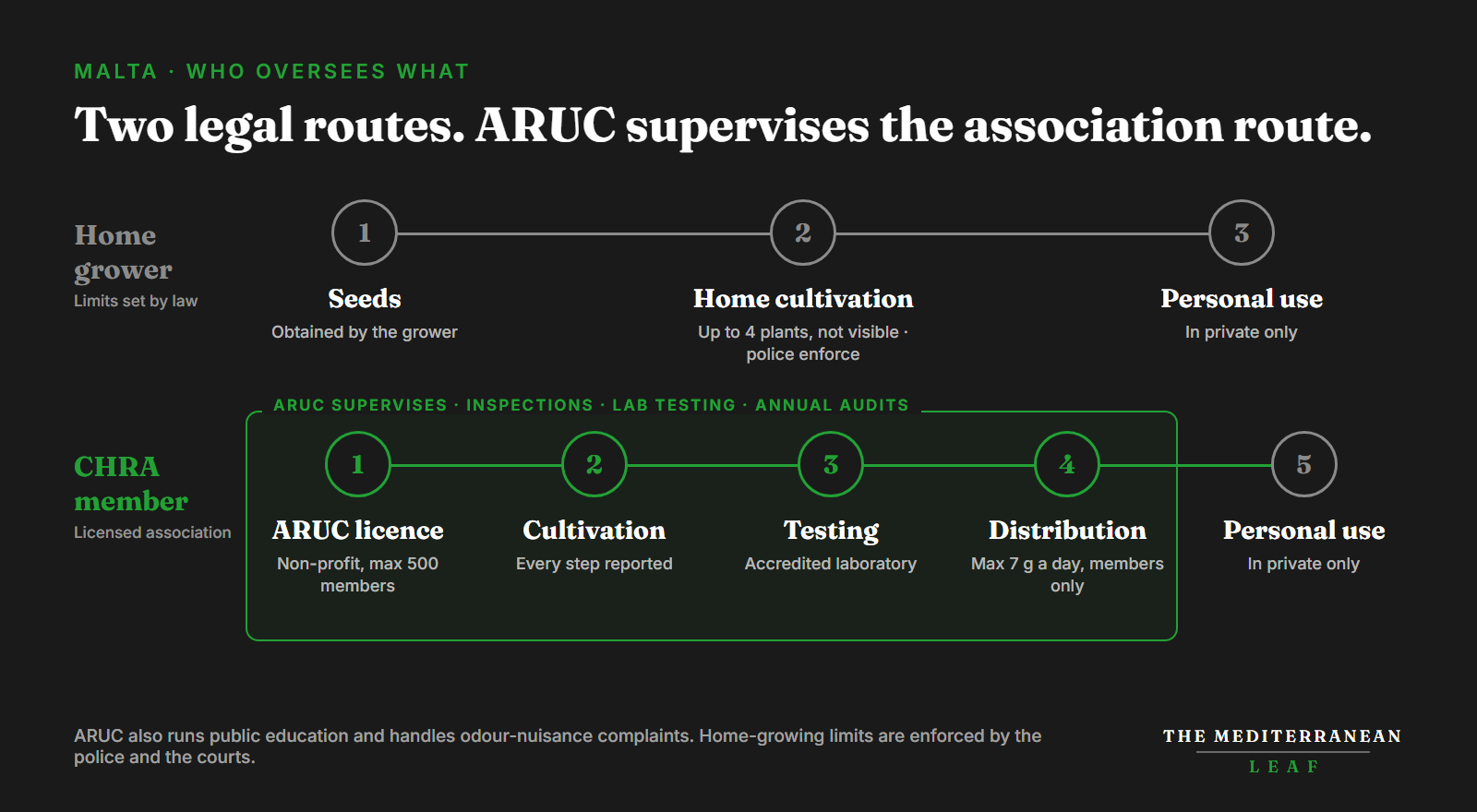
The model has limits. Visitors have no legal way to obtain cannabis in Malta, the 500-member cap keeps every association small, and public consumption is still a fineable offence. But of the five countries compared here, Malta is the only one in which every link — personal use, home growing, non-profit supply and specialist oversight of that supply — is written into law, with a dedicated authority supervising the association route from seed to member.
Why the comparison matters
Spain shows what happens when clubs grow faster than the law: years of court cases and uncertainty. The Netherlands shows that tolerating sales without regulating supply keeps criminal suppliers in business for decades. Portugal shows that protecting users is not the same as giving them a safe source. Germany shows how hard it is to scale a club model across a large federal country.
Malta has already done what its neighbours are still debating. That is why the way its own ministers talk about the system matters: a framework this carefully built deserves to be explained and defended, not mentioned only when a new penalty is announced. We made that argument in our editorial, Malta Built a Cannabis Model That Works. Its Ministers Should Start Defending It.
Updated 19 November 2026 to clarify ARUC’s remit on home cultivation.
Sources:
- EMCDDA (now EUDA), "Cannabis laws in Europe: questions and answers for policymaking", June 2023 — https://www.euda.europa.eu/publications/faq/cannabis-laws-europe-questions-and-answers-for-policymaking_en
- Drug policy of Portugal (Law 30/2000, dissuasion commissions, 2018 medical law) — https://en.wikipedia.org/wiki/Drug_policy_of_Portugal
- Business of Cannabis, "Is Cannabis Legal in Spain? Clubs, Courts and a Market in Limbo", 2 October 2026 — https://businessofcannabis.com/is-cannabis-legal-in-spain-clubs-courts-and-a-market-in-limbo/
- DAM Live, "The Wietexperiment Live Tracker" — https://damlive.com/law/wietexperiment-tracker
- Cannabis Health News, "Germany's Cannabis Act Two Years On — What The Data Shows", 8 April 2026 — https://cannabishealthnews.co.uk/2026/04/08/germanys-cannabis-act-two-years-on-what-government-data-shows/
- The Mediterranean Leaf, "Malta Cannabis Guide" — https://themediterraneanleaf.com/malta-cannabis-guide/
- The Mediterranean Leaf, "CHRA Regulations Guide" — https://themediterraneanleaf.com/chra-regulations-guide/
Members Discussion