
Culture & Community
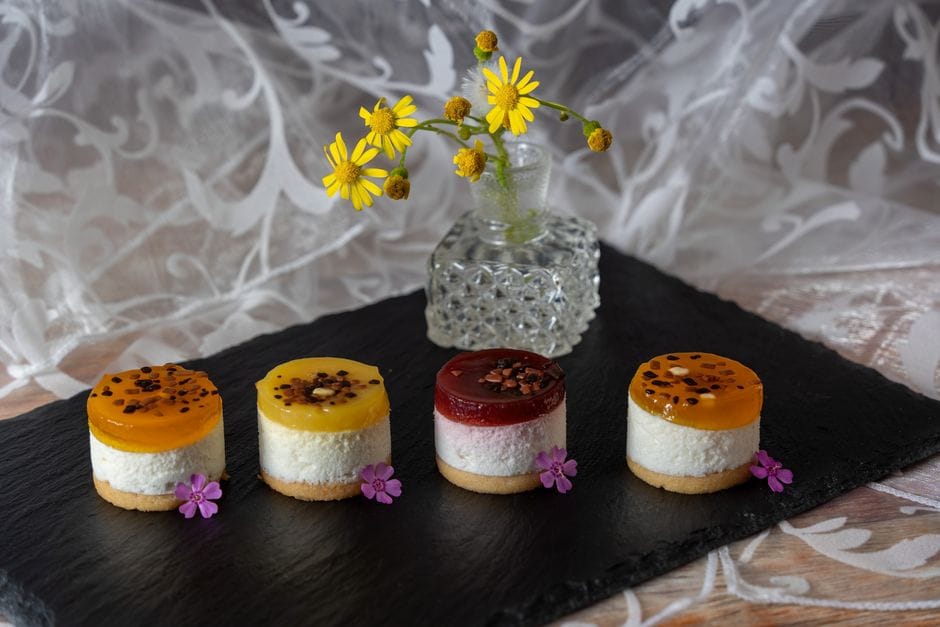
Cheesecake has survived roughly 2,800 years of human appetite. According to food historians, something resembling it appeared at the ancient Greek Olympics of 776 BCE — a baked mixture of wheat, fresh cheese and honey, dense enough to fuel athletes through competition. It was practical food dressed up as a treat. That balance — indulgent but functional — has never really gone away.
What did change, decisively, was the invention of cream cheese in the twentieth century. The soft, stable, slightly tangy block we now reach for in every patisserie transformed cheesecake from regional curiosity into a global staple with hundreds of variations. And somewhere in that proliferation, inevitably, came the cannabis kitchen version.
The recipe below — adapted from a formulation published by Revista THC — pairs a cannabis-infused butter base with coconut and passion fruit. The tropical combination is not accidental: coconut adds richness that complements the earthy undertone of cannabis butter, while passion fruit brings a sharp, acidic finish that cuts through both. It is a recipe designed to taste good, not merely to deliver a dose.
A Note on Cannabis Butter Before You Begin
Cannabis butter — sometimes called cannabutter — is the foundation of most cannabis baking. It works because THC, the principal psychoactive compound in cannabis, binds to fat during a low-heat infusion process. Butter, being largely fat, is an efficient carrier. The potency of your final cheesecake depends almost entirely on the quality and strength of this butter, which is why dosage discipline matters more here than in almost any other form of consumption.
The recipe calls for 100 grams of cannabis butter across six portions — which works out to roughly 16–17 grams per serving. If your butter was infused with a standard-potency flower, that is a meaningful dose for an average adult consumer. For anyone new to edibles, the golden rule applies: start with a small portion, wait at least ninety minutes before considering more, and never combine with alcohol. Edibles metabolise differently from inhaled cannabis — the onset is slower, the effect is longer-lasting, and misjudging it is easier than most people expect the first time.
The Recipe: Cannabis Cheesecake with Coconut and Passion Fruit
For the base: Process plain biscuits (digestives work well; coconut biscuits work even better) into fine crumbs. Melt 100g of cannabis butter and combine with the crumbs until the mixture holds together when pressed. Line individual ring moulds with foil and press the base mixture firmly into the bottom of each. Refrigerate while you prepare the filling.
For the filling: Blend cream cheese, sugar, eggs, coconut cream and a splash of vanilla until completely smooth. The mixture should be thick but pourable. Distribute evenly into the prepared moulds, filling each to just below the rim.
Baking: Place in an oven at a moderate heat — around 160–170°C — for 20 to 30 minutes. The cheesecakes are ready when the edges are set but the centres retain a slight wobble. Do not overbake. Remove and allow to cool completely before adding the topping. The recipe yields six to eight portions depending on the size of your moulds.
For the passion fruit topping: Combine the pulp of four or five ripe passion fruits with two to three tablespoons of sugar in a small saucepan. Heat gently, stirring, until the mixture thickens to a loose jam consistency. Remove from heat and allow to cool slightly, then spoon over the surface of each cooled cheesecake. The tartness of the passion fruit at this stage is what makes the whole thing work — without it, the richness of the coconut and cream cheese would dominate.
On Labelling, Sharing and Common Sense
If you are making this for a group, label it clearly. This seems obvious but is worth saying plainly: cannabis-infused food looks identical to its non-infused equivalent, and an unsuspecting guest consuming a full portion without knowing is not a funny story — it is a genuinely unpleasant experience for them and an avoidable one for you. In Malta, where adult-use cannabis operates under the harm reduction framework established by Malta's 2021 cannabis reform, responsible sharing is not just an ethical consideration — it reflects the broader principles the entire regulatory model is built on, as outlined in our ARUC Compliance Handbook.
Keep portions individually sized — which this recipe already does, by design — so guests can make an informed choice about how much they consume. Store any leftovers in clearly labelled, sealed containers, away from children and from anyone who did not opt in.
Why This Recipe Works Beyond the Cannabis
The most underrated thing about cooking with cannabis is that it forces you to think about what you are actually making. You cannot approach a cannabis cheesecake casually, because the butter preparation requires attention, the dosage requires calculation, and the serving requires care. That discipline, it turns out, makes for better food. The tropical flavour combination here — coconut, cream cheese, the sharp hit of passion fruit — would hold up without the infusion. The cannabis is an addition, not a crutch.
Perhaps that is the best way to approach the cannabis kitchen in general: make something genuinely good first. The rest follows naturally.
Featured image: Photo by Gundula Vogel on Pexels
Members Discussion