
Culture & Community
A Plant Under Constant Siege
Every cannabis plant growing under lights or in open soil is, from a pathogen's perspective, an extraordinarily attractive target: a concentrated source of water, sugars, and minerals, packaged in a structure that cannot run away. The fact that most plants survive this relentless pressure is not luck. It is the result of hundreds of millions of years of evolutionary engineering — a two-layered immune system that operates around the clock, largely invisible to the grower tending the crop.
Understanding how that system works is not merely an academic exercise. For cultivators, it has direct implications for how they manage their growing environment, what stresses they subject their plants to, and how they interpret early signs of infection or infestation.
The Grow-or-Defend Dilemma
At the heart of plant immunity lies a fundamental trade-off. The sugars produced through photosynthesis and the minerals absorbed through the root system are finite. A plant that allocates more resources to immune defence necessarily allocates fewer to growth, flower production, or resin synthesis. This "grow or defend" tension shapes almost every aspect of how a cannabis plant responds to its environment.
When stress is chronic — persistent humidity, repeated pest pressure, root zone problems — plants divert energy toward defence at the cost of yield. This is one reason experienced cultivators treat environmental stability not as a comfort measure but as a yield strategy.
Knowing Your Enemy: The Pathogen Categories
The organisms that threaten cannabis fall into several broad categories — fungi, bacteria, viruses, oomycetes, nematodes, and arthropods — but they do not all attack in the same way. Plant pathologists classify them by their relationship with the host plant, and the distinction matters enormously for management.
Biotrophic pathogens — including powdery mildew and many viruses — complete their entire life cycle on a living plant without killing it. The damage they cause is slow and cumulative, which makes them insidious. By the time symptoms are unmistakable, the infection may be well established. Eradication is often extremely difficult and, in some cases, impossible.
Necrotrophic pathogens — Botrytis (grey mould) being the most notorious example in cannabis cultivation — kill plant tissue and colonise the dead matter. They spread rapidly once established, which means early detection is critical. The good news is that they are generally more controllable than biotrophic organisms once caught in time.
Hemibiotrophic pathogens begin as biotrophics — quiet, slow, seemingly benign — then switch to a necrotrophic strategy once they have colonised a significant portion of the plant. The oomycete Phytophthora infestans, infamous for causing the Irish potato famine, belongs to this group. The initial biotrophic phase is particularly dangerous because it so easily goes undetected.
The First Line: Preformed Defences
Cannabis plants do not wait to be attacked before defending themselves. Their first line of immunity is always switched on — a set of structural and chemical barriers that pathogens must overcome before they can cause any real harm.
The most fundamental of these is the cell wall itself: a dense, elastic mesh of cellulose and other complex molecules that surrounds every plant cell. For a pathogen to infect the plant at the cellular level, it must first breach this wall — no trivial task.
The plant's outer surface adds further chemical defences. Compounds from the saponin family are present on the epidermis of many plants and act as natural disinfectants, disrupting the membranes of pathogens on contact. Other molecules — glucosinolates — sit in an inactive state until cellular damage triggers enzymes that convert them into highly toxic compounds, essentially deploying a chemical weapon at the point of injury.
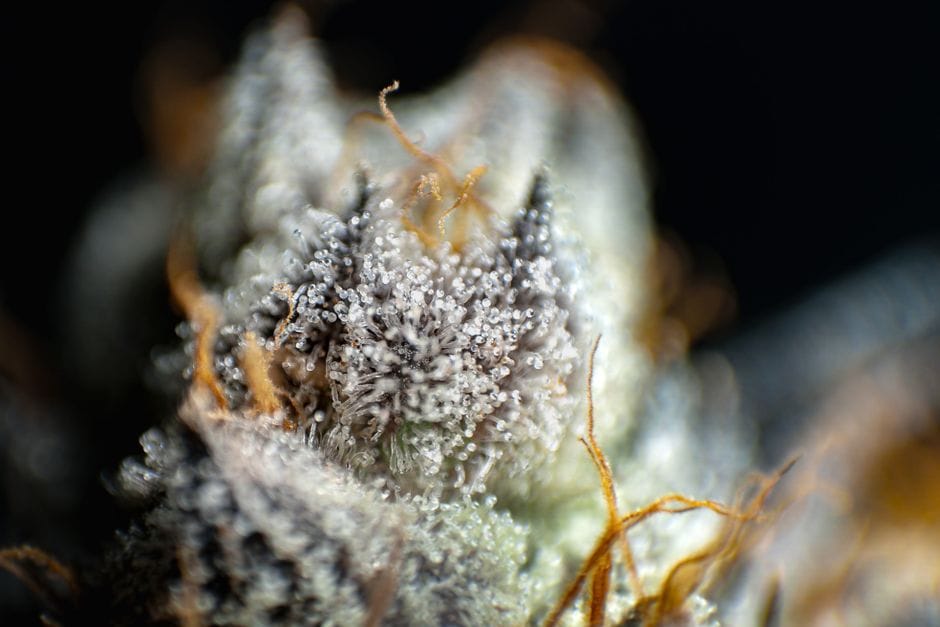
For cannabis specifically, one preformed defence structure deserves particular attention: the glandular trichome. These resin-producing structures — the same ones responsible for cannabinoid and terpene synthesis — also serve a direct defensive function. Under physical attack from insects or mites, trichomes rupture and release a sticky resin that can immobilise small arthropods, slowing or halting their movement across the plant. The same structures that make cannabis medically and recreationally valuable are also part of its immune architecture.
The Second Line: Innate Immunity
If a pathogen manages to penetrate the preformed barriers, it encounters the plant's innate immune system — a sophisticated, inducible response. Every plant cell carries receptor proteins on its surface and within its interior that function as molecular sentinels, capable of recognising specific signatures associated with particular types of pathogen: bacterial proteins, fungal cell wall fragments, viral RNA.
Once a receptor detects an intruder, it triggers a cascade of responses — cell wall reinforcement, the release of antimicrobial compounds, and in some cases deliberate cell death to create a quarantine zone around the infection site.
What makes this system biologically fascinating is the evolutionary arms race it implies. Pathogens continuously evolve new molecular tools to evade plant receptors. Plants, in turn, evolve new receptors to detect those tools. It is a slow, silent war written into the genome of every plant — and cannabis, like all cultivated species, carries the accumulated record of that war.
What This Means for Cultivators
Recognising that cannabis has an active, resource-dependent immune system reframes several common cultivation debates. Environmental stress — temperature swings, overwatering, light burn — does not merely slow growth. It compromises immune readiness, leaving plants more vulnerable precisely when pathogens are most likely to exploit weakness. Maintaining stable, appropriate growing conditions is, in part, an immune support strategy.
It also suggests that early intervention matters far more than the pathogen category might imply. Whether a grower is dealing with the slow creep of powdery mildew or the sudden collapse of a Botrytis infection, the plant's own defences are working in parallel — and giving those defences the best possible conditions to operate is always part of the response.
Understanding the biology will not replace good scouting practices, environmental controls, or appropriate treatments. But it does offer something useful: a way of thinking about the plant not as a passive victim of disease but as an active participant in its own survival.
Sources
Revista THC, "El sistema inmune de las plantas de cannabis": https://revistathc.com/el-sistema-inmune-de-las-plantas-de-cannabis/
Featured image: Photo by Diego Barros on Pexels
Members Discussion